Category Archives: On Writing

Retired and Writing

   (Note: Due to a personal commitment, this week’s blog entry is appearing two days early. Assuming normal inspiration, the next entry will appear at the usual time, i.e., on Friday, 5/2.)

As of today, 23 April 2014, I became officially unemployed. As in retired. Although a well anticipated event, its arrival is going to take some time for mental adjustment. It’s just a bit weird not to be getting up for work, and having no more professional responsibilities after 42 years in medicine since graduating from medical school.

Those who know me well know that I’ve got no shortage of interests and activities to keep me occupied, major among them being writing. With a number of published articles, two books in print, and an essay due to appear in an upcoming issue of a literary journal for medical professionals, I’ve managed to build a body of work that’s taught me much about how to construct pieces for publication.

Writing has been something I’ve loved doing at least as far back as the 7th grade. It began almost as a byproduct of my lusting over a fountain pen. Oh, and not just any fountain pen. No, sir. It was a $1.00, clear barreled Sheaffer fountain pen sold by the student store at Northridge Junior High School. Over a period of years, until I could afford better, I owned several of them as well as similar ones by Wearever. They all leaked, staining my fingers and shirts, but I didn’t care. I was in love with real, flowing ink. I still am, and I treasure the wonderful non-leaking pens I’ve since acquired.

But, I digress.

As soon as I got that first Sheaffer, so did my best buddy, Sam (not his real name), and we started writing little essays of a sort, calling each one an installment of a series called “My Innermost Thoughts”. Sam and I each did this during class time and, somehow, never got caught. I wish I still had those little essays, but the nearest I have to my creative writing from that time is a short paragraph in which I said I thought I’d be a doctor when I grew up. This, actually, was terribly odd, if prescient, since I cannot ever remember wanting to be a doctor until late in my freshman year of college. Until then, I had planned on being an engineer or a physicist, like a first cousin once removed who was with the Applied Physics Laboratories at Johns Hopkins University and was involved in sending up some of our earliest communication satellites.

It was in college that my writing took off. I vomited a great deal of terrible poetry, tried without any recognized success to generate funny stuff for the school’s humor magazine, and (did I mention?), upchucked a lot of really bad, self-indulgent poetry. Every word, incidentally, was written with a fountain pen before getting typed on a blue Royal Futura manual typewriter that skittered across the desk every time I hit the carriage return . By then, though, I had graduated to $5 Parkers that I could fill from a bottle. They leaked a lot less than the Sheaffers.

Writing went largely on hold through medical school, internship, and residency, but once in the private practice of obstetrics and gynecology, I found myself spending long hours in the hospital attending labors and deliveries. Partly to kill time, I began to write again. The first draft of my story, “Spacebraid”, was written mostly in the on call rooms at two hospitals where I spent seemingly endless hours waiting out the often long process of labor. Ultimately, and through several re-writes, “Spacebraid” became the lead story in my first published book, Spacebraid and Other Tales of a Dystopian Universe. It was at that time that the story was almost optioned for film or TV production by a major studio. Unfortunately for me, the studio ultimately decided to take a pass.

I’ve been writing ever since, albeit sometimes in spurts separated by longer periods of inactivity. Zendoscopy was a project that took several years to complete. It’s obviously a much more personal effort than Spacebraid…, with many of its episodes being outlandish riffs on kernels of truth.

Here’s what’s coming on my writing calendar:

  • Saturday, May 3: Book signing for Spacebraid and Other Tales of a Dystopian Universe and Zendoscopy at Mysterious Galaxy in Redondo Beach from 3-5 PM. The store is located at 2810 Artesia Boulevard, about two blocks west of Hawthorne Blvd.
  • Wednesday, June 18: Author appearance at Wanda’s Readers, a book club in Redlands that has chosen Zendoscopy as its June read.
  • Summer 2014: Publication of my essay, “An Obstetric Story”, in The Pharos, the literary journal of Alpha Omega Alpha, the medical honors society.

With some luck, more signings will be scheduled over the next few months. And, of course, the writing continues. Stay tuned.

Today’s Annoyance: Hey! I just retired! Nothing bothers me this week.

It has been said that writing is easy. All you have to do is sit down and open a vein. Actually, what I’ve found is that while writing may take considerable effort, it’s not harder than getting your writing out to an audience.

As readers of this blog and others who know me are well aware, I’ve been writing for a long time. I’ve had articles published in a variety of places: the medical literature, hobby magazines, innumerable letters to the editors of many publications, and organization newsletters. My first book, Spacebraid and Other Tales of a Dystopian Universe, was published in 2004. My latest, Zendoscopy, was published earlier this year.

The magazine and newsletter articles had built-in audiences and there were no issues related to marketing. For the two books, however, it has been a very different story. I’ve previously written about the near-impossibility (actual, in my case) of getting an agent when one is an unknown writer, and without an agent, sending manuscripts directly to publishers is simply to have one’s work buried in massive slush piles. The solution, self-publishing, gets one’s book into print but that can be a dead end unless there’s a marketing effort to follow, an effort that needs to be fueled with more money than the initial publishing cost.

Here’s the history and current status of Zendoscopy. The book was published in late January. I posted this on my main Facebook page and revised the page that previously touted Spacebraid…, renaming the page “Books by J. Allan Wolf”. I did a 10 day ad campaign on Facebook and wrote about publication issues on the blog. I’ve set up a book signing for 3 May at a local bookstore and I’ve managed to get the book into the gift shop of the Palos Verdes Library in Rolling Hills Estates, near home. I’ve sent a copy to a local NPR radio station’s morning general interest program but, after more than three weeks have heard nothing from them. On 7 May I expect a Kirkus review to appear. I’ve got a supply of custom bookmarks and the publisher has templated several pitch letters and a PR blurb for me. Today, I had a local FedEx (ex-Kinko’s) do a nice mounted 11 x 17 poster of the cover for $7.50 to use at the 3 May signing. The book is available through many online booksellers including Amazon.com, Amazon Kindle, Barnes and Noble, et al.

I know that some copies are selling, but they’re not exactly flying off the shelves (or into tablets). I can’t afford ads in major newspapers and magazines, and so far no widely read reviewer has picked it up, although I plan to send out some copies to reviewers in the hope that, perhaps, one will read it and like it enough to write something nice about it. Of course, that could easily backfire.

So that’s where things currently stand. If you’re an aspiring writer without connections who’s going to dive into self-publishing, you need to know that it’s unlikely you’ll make a fortune on your masterpiece. Still, it shouldn’t keep you either from continuing to write or continuing to try to get your work to a target audience. If you have faith in your work, that’s what you’ll do. Craft it carefully, be open to input from anyone you trust enough to read it, get it thoroughly proofed before it goes to publication, get a good cover design, and then market it to limits of your budget. Follow this blog for updates on the progress of Zendoscopy, and if you haven’t yet gotten your copy, just remember: I can use the royalties.


Today’s annoyance: Overuse of the exclamation mark.

I subscribe to a magazine that regularly publishes articles by a writer who is addicted to exclamation marks! Every strongly worded, declarative sentence he writes ends with one! I’m not kidding! They just keep coming! It drives me crazy! I wish he’d stop! Unfortunately, I doubt that he ever will!

On Marketing Your Opus Magnum

As a relatively unknown, self-published author, you have to face the fact that it’s difficult to gain much market traction. Advertising is expensive, major publications don’t want to add your opus magnum to their slush pile, some booksellers will rip you off for the privilege of allowing an onsite book signing (boy, do I know about that one), and getting a review from a respected reviewer is nigh onto impossible. So, what can you do?

My own personal experience with this has been spotty. I was highly naïve following publication of my first book, Spacebraid and Other Tales of a Dystopian Universe, and my marketing efforts, to be honest, sucked. I did manage a couple of short reviews in niche publications that got me no sales. Then, figuring I needed to go bigger (read: spend more), I took a several month ad in Analog, a science fiction magazine with a circulation of about 80,000. After some four months of running the ad, not a single book had sold. Was this depressing? You betcha.

As I’ve previously described at some length, the publisher of Spacebraid…  was not at all helpful in the marketing of the book. They offered expensive marketing services which mostly involved their sending out some publicity blurbs via distribution e-mail (i.e., spam) and getting the book listed in indexes seen only by bored Himalayan hermit librarians, and I got no boost from those.

Eventually, I made two decisions: spend no more on Spacebraid… and find a new publisher for my second book, Zendoscopy. The first was easy. I no longer take calls from the high pressure salespeople at Xlibris. The second took some time to find, but I settled on Inkwater Press in Portland, Oregon. The attention and support I’ve gotten from Inkwater has been most encouraging, and what I’ve liked most is that when I call them, human beings pick up the phone and they actually know who I am.

Publication of Zendoscopy went smoothly and I’ve now got a few copies in my closet with more ordered. So, how am I going to do the marketing this time? Well, I’ve learned a lot since my first experience, so now, at least, I’ve got a plan.

Immediately upon receiving my first shipment of books, I contacted Inkwater and had them set up a book giveaway on the Goodreads website. They also did a publicity release and a couple of pitch letters for me on their letterhead which I can use as I please. I had bookmarks printed up that I can distribute or leave in batches in bookstores and elsewhere. (Actually, I did do the bookmark thing with Spacebraid…, too.) None of this was free, but Inkwater’s fees were bundled into a package at reasonable cost. Next, I requested a review from Kirkus, a reputable and well known organization which, for a price (of course), will review your work and provide you with an independent review that you can choose whether distribute or not, based upon how it turns out. At your direction, they will also distribute or bury the review as you prefer. The Kirkus  review of Zendoscopy is pending as I write this, and probably won’t be available until early May. If it’s favorable, it should help sales considerably.

A few other actions. First, I will be sending a copy to the host of a local NPR radio program, hoping he’ll read it and respond to my suggestion of an on-air interview. Second, despite my prior bad experience with a local bookseller over a book signing, I will try to schedule several of these with stores that won’t cause me to lose money on every sale. Third, I’m experimenting with a new online marketing site called TweetInto that links with Twitter. The site functions to connect your tweets with other Twitter/TweetInto users who will re-tweet your advertising tweets. I’m still learning how to use the service and whether it will make sense, but for a minimal investment of $20 to get started, I figure it’s worth a try.

I am very fortunate in that I’m able to write because I love to do it and not because I need to make my living as a writer. Despite having many articles and two books in print, I’ve made very little from my writing over the years. So, why do I do it? I think the answer I would give is the same as that given by many others: because it is a need. The need to write is something internal that exerts terrible pressure to be let loose. Said in another way, I write because I have to write. Selfish? Maybe. But whether you read what I put on the page or simply ignore it is up to you and not really a problem for me. Although I care, I don’t get all twisted up over it. I’m just glad for the decompression I feel as the words escape from wherever down deep they come from to land on the page, where I can see them and, in so doing, see some of myself. For me, that’s enough.

Today’s annoyance: People at the movies who won’t shut up.

The Writer Unleashed

In the spring of 1965, I joined the writing staff of my university’s humor magazine.

Old Jebediah Wormwood sucked on his corncob and rocked rhythmically in his favorite chair on the front porch of the ramshackle shack he shared with the old lady and kids. It was unclear how many kids there actually were since Jeb couldn’t count above eleven, it being too confusing to use all appendages. Abruptly and with an exquisitely timed push, he initiated a syncopated lurch backward just in time to execute the perfect decapitation of a wayward chicken that had strayed under the rocker’s left guillotine. “Dinner,” he mumbled to no one in particular.

That was the approximate wording of the first four sentences of the only piece I ever wrote for the magazine, the original wording being long lost because the story was never published. This may be because I never submitted it. In fact, I’m sure that’s the reason. Why? Because those four sentences were the only four sentences I wrote. It wasn’t that I’d suddenly become overwhelmed with writer’s block. No, it was because I never had any idea of what I was going to write in the first place. Nevertheless, in spite of zero output, I fancied myself a budding writer.

At about the same time, I was rather pathetically in love with a girl I’d been dating for a year or so. Love, however, wouldn’t actually be the most accurate way to describe it. When one’s most ardent feelings aren’t being returned, as mine weren’t, it’s more in the nature of unrequited infatuation. I may have been crazy about her, but she always remained at some emotional distance from me. This made me crazy, so I started writing poetry. Very bad poetry. The kind of self-indulgent, agonized poetry that can only spring from the frustrated loins and breast of a suffering college male. This would not help my writing career.

All during this period, I would discuss writing with a fellow classmate who lived a few doors from me in the dormitory. As was I, he was a pre-med student, but with a difference. I, at least, was interested in science and medicine and getting good grades. He was bored and, to make matters worse, a terrible student. On the other hand, while I was writing term papers, he was actually writing stuff that was getting into the humor magazine. I was envious; he was worried about flunking out. I went to med school; he actually became a successful writer. The first time I saw one of his pieces in Playboy, I almost threw up out of sheer jealousy.

Sometime after graduation from college, I heard the old disparaging remark about everyone wanting to write the great American novel and thought, if that’s true, than I’m a hopeless sheep in the crowd. But I decided to try it again.

Several published articles in various magazines and journals and two books later, I’m a writer, albeit still a pretty unknown one. The lessons I’ve learned along the way about generating content are many, but here are a few critical ones:

  • Ideas come but, just as quickly, go, and it’s important to make note of them before they’re forgotten in the crush of other thoughts we have during the day.
  • If you dream a vivid experience, write it down as soon as you awaken, even if it means keeping a notebook at the bedside. It’s really frustrating to know that you had a great idea when you feel it slipping inexorably through the sieve of your neural network. On the other hand, be merciless. What seems great in the dream may be dreck in the light of day.
  • Don’t discuss what you’re currently working on with others unless you’re asking for input that you really want from someone you respect. And if you ask for input, accept it graciously even if you don’t like it. After all, you asked.
  • Be receptive of, or thick-skinned in the face of, criticism of the published work, as it will help you for your next opus. Not everyone will love what you write, and reviews, especially those entered anonymously or semi-anonymously on sites like Amazon.com, are sometimes on the mark but just as often may be rude and witless. And, while we’re on this, be careful about asking your friends to post reviews. Only do it if you’re sure they liked your work…a lot. I can think of little that will upset you as a writer more than to have a friend lambaste you on the web in a review that you requested.
  • Read a lot; write a lot. Your writing will improve as you continue to do both.

As I have readily admitted, I’m still pretty much unknown as a writer, so for me to be giving advice might seem presumptuous. If you’ve read the pointers above, though, I hope you’ll understand that I’m only relating a few guidelines and suggestions drawn from what I’ve learned from my own experience. If it’s helpful, great. If not, so be it.

Today’s Annoyance:

If you think the word is “orientate”, you really need to be re-oriented.


Zendoscopy Now Available!

On Monday, 1/20/2014, I signed off on the final proof copy of Zendoscopy, and on Thursday, 1/30, the book appeared on, and is available from, the Inkwater Press website (http://inkwater.com/books/index.php?route=product/product&product_id=1116). It’s also available from Amazon.com, Amazon Kindle, Barnes & Noble, and just about every other online bookseller. It can also be ordered from any four-walled bookstore. Please note that the cover photo may not appear on some websites for another week or so, but this does not affect the ability to order the book.

   Zendoscopy is the story of a young man’s life from the time of his highly unusual birth through his somewhat stressful youth and into marriage. It is a coming of age tale told in discrete episodes, some serious and some, as described by one advance reader, flat out hilarious. For anyone who’s ever felt that, somehow, he or she didn’t quite fit in with the zeitgeist of the 50’s, 60’s, and 70’s or, for that matter, any other period in history including the present, Zendoscopy  should ignite a spark of recognition, and maybe just an empathetic frisson as both the miseries and the joys of growing up are recalled in stories that will bring you to tears as you remember your own awful, wonderful youth. (Okay, that’s my pitch and, hey, I’m begging you: buy the book – I can really use the royalties.)

Next step, moving copies. Stay tuned over the coming weeks (months?) as I wade nose deep into the wilds of marketing. It should be an “interesting” ride.

Today’s Annoyance

People who don’t understand that “criteria” is the plural of “criterion”. In other words, many criteria are, but one  criterion is.

In similar fashion, I’d harp on “media” and “medium”, and on “data” and “datum”, but commonly accepted usage unfortunately works against me with these. Maybe I have to grit my teeth over them, but I refuse to yield on ”criteria” and “criterion”. Hearing someone use “criteria” as a singular is like scraping fingers on a blackboard, especially when it’s someone who really should know better.

Designing the Cover

So, I’m now deeply into the pre-publication design and proofing of Zendoscopy, my second book. It’s a sort of a coming of age story told in discrete episodes, chapters in the life of my protagonist. So, what should the book’s cover design be?

Early on, I submitted several possible designs to my publisher, including those below:

Zendoscopy Front Cover Zendoscopy Unusable Cover 1 Zendoscopy Unusable Cover


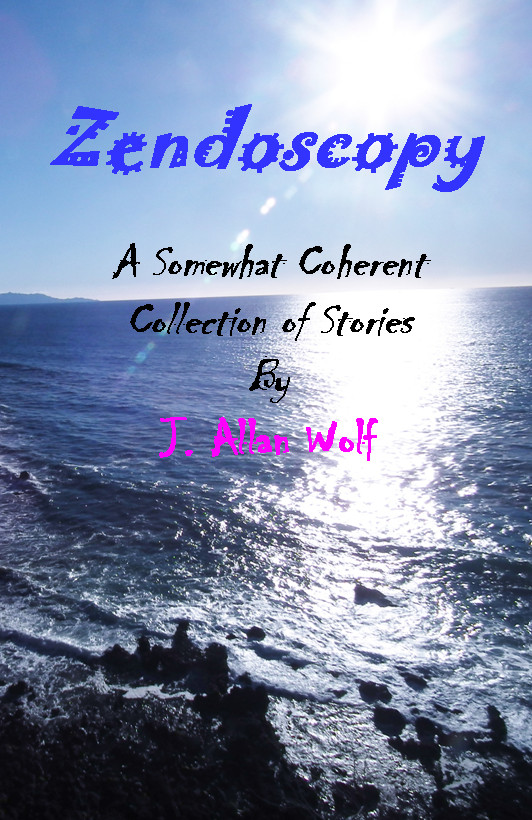
All were rejected. The bright, almost psychedelic covers were deemed too colorful for the standard mode of cover printing. The photograph was eliminated because it had nothing to do, really with the theme of the book. The graphic designers at Inkwater also hated the font I had used. All in all, they told me the designs I had submitted were, um, unprofessional. Personally, I thought they were kind of cool, but I did get the bit about the one with the photograph being irrelevant. Oh, and there was one more thing about the bright covers: I couldn’t get the rights to the psychedelic design. I sent multiple e-mails to the wallpaper & background site where I found the basic pattern, but never could get any response, even though I offered to pay for the design. Incidentally, the difference between the two is that I posterized the brighter one.

So, what to do? One of the graphic designers suggested that I look at covers of books published by MacMillan, Simon and Schuster, Hachette, et al., which I did. I hated them all, ending up seeing a lot of really dull covers. You can verify this yourself. Go to your local Barnes & Noble and check out book covers from major publishers. Dull, right?

A second graphic designer at Inkwater sent me some sample backgrounds she had located. I pretty much hated them, too. Dull to the point of awful. The pages with those designs, however, did have links to other designs, which I followed. Although not entirely happy with what I found, I did locate one design that was sort of acceptable to me and which met with approval at Inkwater. Their graphic designer went to work on it and, miracle of miracles, the cover looks pretty damn good. You’ll see it soon enough.

Interior design of the book is a much simpler matter. Words on a page, pretty standard font, a few design tweaks, and done.

In the final analysis, the job is to get books moving off the shelf, book-signing table, and internet. If looking “professional” is going to get the writing more seriously considered by book reviewers and acceptable to booksellers, then, with some regret, my attempts with psychedelia and photography have to be abandoned. Who knew?


Today’s Annoyance: The Dangling Phrase

“Running through the forest, the foliage became thicker.” So, foliage can run?

  “Screaming in pain, bystanders quickly came to his aid.”  Were the bystanders really in that much pain?

“Ducking under an awning for cover, the rain was coming down harder and harder.”  I didn’t know that rain could duck.

An Echo

An echo of my last posting: Today I received a telephone call from my “personal representative” at Xlibris, wanting to know whether I want to buy more books. As a clear, simple, declarative statement, I said, “No.” He then said, “Well, I note that you bought paperbacks last time. So, would you like to buy hardbacks this time?”

Today’s Annoyance:    I think my “personal representative” is annoyance enough for today.

On Finding a Publisher: Advice from Experience

If you’ve just completed your opus magnum and are seeking a publisher, this cautionary tale may be of interest. We resume here the tale begun in my prior posting.

So…when I found myself unable to get an agent for Spacebraid and Other Tales of a Dystopian Universe, I realized that the only way the book would ever see publication was for me to do it myself. Knowing nothing but doing some internet searching, I settled on what I thought would be a solid publisher as the one to do the book for me.

At the time, the company, Xlibris, made much of its relationship with Random House, which was an investor and, as I recall, had a seat on the company’s board of directors. This lent it an air of respectability and made it a bit more than many other vanity press publishers, in that it offered more to the writer than just printing books. Besides its relationship with a mainstream publisher, included in its menu of available services were a variety of editing and marketing plans, all available according to a fairly steep pricing schedule. After some thought and a hard look at my budget, I took a basic publishing package for about $1000 which got the book into print and distributed a press release. I was fortunate in that my daughter Beth, a skilled artist among her many talents, created the cover for me, saving me a bundle on design.  I then had some advertising bookmarks made up and, before long, I held copies of my opus magnum in my greedy little hands.

Effective marketing is very expensive, easily running to many thousands of dollars, and I simply didn’t (and still don’t) have the budget to market as effectively as I wish I could. So, despite much excellent marketing advice from my other talented daughter Laura, the book has languished, with only occasional sales despite some modest ads and word-spreading I’ve undertaken since publication in 2004. As indicated in my initial posting (with links to sites), Spacebraid…  is currently available from all the major online booksellers and as an e-book on Kindle.

Over time, I’ve become significantly disenchanted with Xlibris and cannot recommend the company to others. What’s the problem? For starters, I recoil at their high pressure sales tactics executed by a staff with poor English skills. I’ve come to dread the periodic telephone calls I receive from these people, who push expensive marketing packages that simply don’t pay off in sales. How do I know they don’t work? Because initially I bought in and spent a fair amount of ill-afforded cash on company programs that didn’t even yield token sales – they yielded no sales.

Most recently, I got another call from the umpteenth poorly spoken sales hack I’ve heard from over the years since publication. This guy tried to sell me a package of 100 books plus e-mailings of a press release to 100 media outlets for…$1100 and change. Think about it. What he wanted me to do was to buy 100 books and he’d send out a distribution e-mail “for free”.  What I need isn’t 100 more books stacking up in my garage. Or an e-mail ending up in 100 outlets’ spam folders. What I need is effective marketing, and that ain’t it.

As for the English skills of the folks who keep calling me – and note that it’s a different person each time who proclaims himself or herself to be my personal representative – they’re abysmal. Trying to obtain any useful information or transact business with these folks is sheer torture (say, what time is it, anyway, in Bangladesh?), as their understanding of my questions requires endless explication, and their explanations of what they’re trying to sell are often impossible to follow. Further, their sales approach involves totally ignoring what I tell them. Example: I did want to order some books for a book signing recently. I told my “personal representative” that my budget was $500 as a maximum. He immediately quoted me a package for $800.  I reminded him of my stated budget and he came back at $650. After some considerable haggling, we finally settled at $511 for 40 books at a substantial discount off the “retail” price – sort of like bargaining for a car with the always bogus MSRP. Only after the books arrived did I realize that, under the usual arrangement with authors for book signings at my local independent bookstore, I’d lose $3 on every book I sold. (If you want an autographed one, let me know in a comment — I won’t publish your contact information. They’re going at the fire sale price of $12 per copy.)

Finally, and even more distressing, while these salespeople represent themselves as your special representatives, I’ve not yet encountered one of them who has read my book or even has any idea of what it’s about. Worse, they stumble on the title when they try to reference it. Apparently, “Spacebraid” and “Dystopian” are hard words, especially when simple English is hard enough to articulate. Personal representatives? Hah!

And so, we come to the bottom line, and it is be careful. Be very careful when you select your publisher. Do some research. Ask the publisher for references and, if you get them, actually contact them. If you can’t get references, there’s probably a reason.

I’m currently working with a different and very well recommended publisher for my second book, Zendoscopy, due in March. I’ll be reporting on how that’s going in a later posting. In the meantime, keep on writing if you’re writing, keep on reading if, well, you’re reading, and don’t jump into any publishing arrangement without thoroughly investigating your options and checking those references.

Today’s Annoyance:

Use of the word mitigates when what is meant is militates. Example of correct word usage: “The fact of his stupidity militates against his holding any position of responsibility.” With all due respect to William Faulkner, famous for  making the mistake (e.g., “Centaur in Brass”), the correct word in the example is seen to be militates, not mitigates. As the late, great Casey Stengel used to say (and as James Thurber titled his famous short story), “You Could Look It Up.”

What? Another blog?

2 January 2014

Welcome to Seductive Peach! I know what you’re thinking.

It’s just what the world needs –  another blog. And, worse, an eclectic blog with literary aspirations. Well, to be honest, I’ve been ambivalent, myself, about doing this for quite some time. But with publication of my second book, Zendoscopy, due in March, I thought I’d give it a whirl and see what happens.

To get things started, a bit of background about, er, me might be in order. In the late 1980s, I finished writing my first book, a novel entitled Panope’s Pride. With brutal honesty, I’ll admit that it wasn’t very good and, in truth, I wasn’t overly happy with it. Nevertheless, I had put a fair bit of sweat equity into its creation and so I did try to get it published. It didn’t happen, and the lesson I learned at the time was that I’d never get a big name publisher to take on my work if I didn’t have an agent pushing it, and I’d never get an agent because I had no track record of having my fiction previously published. It was the true embodiment of Catch-22. Stuck in a dead end with a not very well written novel and not knowing at that point what to do with it, yet unwilling to bear the pain of burning the manuscript in my living room fireplace, I stuffed it into a box and squirreled it away, out of sight and mind.

While working on Panope’s Pride, I was simultaneously tinkering with the sci-fi/horror/fantasy realm, and I wrote a story called “Spacebraid” about a group of people who time travel from the near future and environmental disaster to a better time, when the earth has healed. The story was briefly pulled out of the slush pile at a major Hollywood studio and considered for optioning as a film project. Ultimately and to my great disappointment, the studio decided to pass. Although disheartened, I really liked “Spacebraid” and so I went back and revised sections of it that, I thought, improved it considerably as a novella. Then, with seven other short stories, I made it the lead story in a collection called Spacebraid and Other Tales of a Dystopian Universe. Still unable to get an agent, I self-published it.

That was when I learned my second big lesson about publishing, namely, that getting one’s work into print is not the same as selling it. And marketing is both critical and expensive. I took ads and managed to sell a few copies, but my lack of a truly substantial budget for marketing resulted in distressingly few copies soaring out the door despite a couple of nice reviews in niche publications. The book is currently available in both hard and soft copy from Amazon.com, Barnes and Noble online, and from many other online sellers including Xlibris (the publisher), and it’s also available on Kindle. With no professional marketing campaign, though, sales continue to languish. (Shameless plea: If you like sci-fi/fantasy/horror stories, please buy a copy. Or two.)

Sometime ago, I pulled Panope’s Pride out of its hiding place and tapped some of its episodes for a new book. With much new material and revisions through some thirteen drafts, I’ve now completed my second “real” book, Zendoscopy, which is scheduled for publication in March of this year by Inkwater Press. The obvious question, of course, is how to market it. Which, finally, brings me to the proximate and driving reason for starting this blog.

At some point, it occurred to me that a writer’s blog might help not only me but others, as well, to gain a little name recognition. The purpose of the blog, then, is not only to promote my own writing but, periodically, to direct some attention to other writers’ works that might warrant broader attention. Finally, it’s my intention that the site will not shy from the publication of stimulating opinion pieces voicing a range of viewpoints, although I freely admit that the blog will manifest a decidedly liberal and secular editorial bias. And, for the record, flaming will have no place here. All opinion entries will be either fact-based or built on a foundation of solid reasoning and judgment.

So, whether you’re a writer or a reader, consider following The Seductive Peach as it develops over the next few months. And tell your friends. New postings will occur on a regular, if somewhat unpredictable basis. I’ll try to send up a flare on Facebook each time there’s a new entry. With some luck, the effort will be worthwhile for all of us.

And now, this entry’s featured annoyance: “Breaking news!”

Have you noticed that every news program seems to begin with someone announcing, “Breaking news!” Most of the time it’s some lame car chase, a traffic accident, or another murder in downtown wherever. It’s not “breaking”, and usually it shouldn’t even be news. In truth, most of the time it’s a waste of time, and after reporting whatever it is, the newscaster goes on to tell you repeatedly throughout the broadcast what he/she is going to report on “next” instead of actually reporting whatever it is. I watch these programs for the weather report, which is really stupid, since I live in southern California, where there is no weather.