Author Archives: J. Allan Wolf

Unknown's avatar

About J. Allan Wolf

J. Allan Wolf is a writer, a physician (OK, retired), a nerdy ham radio operator, and a bad guitarist. (The groupie thing just hasn't worked out very well.) Read his two books, Spacebraid and Other Tales of a Dystopian Universe (very science fiction-y) and Zendoscopy (very, very funny but also serious in places and explicit -- don't read it if you're a prude). If you buy my books (print or e-book format at Amazon.com, BarnesandNoble.com and elsewhere) I won't have to go without lunches or clean underwear. So, thanks in advance.

It has been said that writing is easy. All you have to do is sit down and open a vein. Actually, what I’ve found is that while writing may take considerable effort, it’s not harder than getting your writing out to an audience.

As readers of this blog and others who know me are well aware, I’ve been writing for a long time. I’ve had articles published in a variety of places: the medical literature, hobby magazines, innumerable letters to the editors of many publications, and organization newsletters. My first book, Spacebraid and Other Tales of a Dystopian Universe, was published in 2004. My latest, Zendoscopy, was published earlier this year.

The magazine and newsletter articles had built-in audiences and there were no issues related to marketing. For the two books, however, it has been a very different story. I’ve previously written about the near-impossibility (actual, in my case) of getting an agent when one is an unknown writer, and without an agent, sending manuscripts directly to publishers is simply to have one’s work buried in massive slush piles. The solution, self-publishing, gets one’s book into print but that can be a dead end unless there’s a marketing effort to follow, an effort that needs to be fueled with more money than the initial publishing cost.

Here’s the history and current status of Zendoscopy. The book was published in late January. I posted this on my main Facebook page and revised the page that previously touted Spacebraid…, renaming the page “Books by J. Allan Wolf”. I did a 10 day ad campaign on Facebook and wrote about publication issues on the blog. I’ve set up a book signing for 3 May at a local bookstore and I’ve managed to get the book into the gift shop of the Palos Verdes Library in Rolling Hills Estates, near home. I’ve sent a copy to a local NPR radio station’s morning general interest program but, after more than three weeks have heard nothing from them. On 7 May I expect a Kirkus review to appear. I’ve got a supply of custom bookmarks and the publisher has templated several pitch letters and a PR blurb for me. Today, I had a local FedEx (ex-Kinko’s) do a nice mounted 11 x 17 poster of the cover for $7.50 to use at the 3 May signing. The book is available through many online booksellers including Amazon.com, Amazon Kindle, Barnes and Noble, et al.

I know that some copies are selling, but they’re not exactly flying off the shelves (or into tablets). I can’t afford ads in major newspapers and magazines, and so far no widely read reviewer has picked it up, although I plan to send out some copies to reviewers in the hope that, perhaps, one will read it and like it enough to write something nice about it. Of course, that could easily backfire.

So that’s where things currently stand. If you’re an aspiring writer without connections who’s going to dive into self-publishing, you need to know that it’s unlikely you’ll make a fortune on your masterpiece. Still, it shouldn’t keep you either from continuing to write or continuing to try to get your work to a target audience. If you have faith in your work, that’s what you’ll do. Craft it carefully, be open to input from anyone you trust enough to read it, get it thoroughly proofed before it goes to publication, get a good cover design, and then market it to limits of your budget. Follow this blog for updates on the progress of Zendoscopy, and if you haven’t yet gotten your copy, just remember: I can use the royalties.


Today’s annoyance: Overuse of the exclamation mark.

I subscribe to a magazine that regularly publishes articles by a writer who is addicted to exclamation marks! Every strongly worded, declarative sentence he writes ends with one! I’m not kidding! They just keep coming! It drives me crazy! I wish he’d stop! Unfortunately, I doubt that he ever will!

Transitions

The course of one’s life is marked by many transitions, some joyful, some full of stress, some tragic, and many perplexingly unexpected. Some happen to us directly and some to others that can affect us in the most profound of ways.
When I was in college, I was very much attracted to a certain young woman whom I felt I could not ask out. She was pretty, vivacious, and she seemed so much more socially adept than I, leading me, as a somewhat introverted pre-bloomer, to feel thoroughly inept in her presence. Even were that not the case, she was a friend’s girlfriend, and the unwritten but always to be observed buddy code absolutely forbade my acting. As a result of all this, I settled for “just friends”. In my senior year, when I got accepted to medical school, she jokingly announced that she’d never let me be her doctor, even if I were the last medicine man on the planet. Everyone who heard her say it had a pretty good laugh. Even me, actually.
Eight years later, I was the chief resident in obstetrics and gynecology in a university teaching hospital, and one day she, this same, lovely young woman whom I had not seen since college graduation, came to see me. Tragically, she had become quite ill with a chronic, debilitating disease but had gotten married before being diagnosed and now wanted a child. Her internist, several other specialists, and I were all most unenthusiastic about this, but she persisted, became pregnant and, sheepishly recalling what she had once said, then asked me to take care of her. I did, and she ultimately delivered a healthy son. She had gone through a courageous, self-determined transition to motherhood involving substantial risk but had come through it well and was now a happy mother, albeit still grappling with her disease. And I? I , too, had gone through a transition, somehow feeling validated as a doctor in a way that I had not before.
After residency, I joined a large ob/gyn practice with six other MDs. At the end of my first year with the group and three weeks after the birth of my wife’s and my first child, the group fired me, essentially because one of the partners and I had had a falling out and he wanted me gone. Once over my shock and disappointment, I decided to open an office about six blocks away, starting my own practice with eleven obstetrical patients who had determined to stay with me and a distressingly large (for my former group) number of gyn patients who also elected to remain with me. The practice became very successful but, after 7 years and for reasons too complicated to detail here, I sold the practice and transitioned my career over a period of several more years from fully clinical to the developing area of administrative medicine, a role in which I have continued to grow and establish myself ever since.
So, why do I bother to relate these few examples of transitions? Because I will very shortly be retiring and, as it is for other transitions in relationships and career activities, retirement is one of life’s major, stressful events.
I’ve been looking forward to retiring for quite some time, and I’m not consciously ambivalent about it at all. But subconsciously is another matter, and recently I’ve been dreaming.
I’ve always had certain recurrent dreams of the kind many people have – nothing unique about that. They’ve always been those in which I’m in situations for which I’m unprepared, often involving time in school when I can’t find the right classroom, keep a schedule straight, or when I’m totally unprepared for some important examination. (I’ve never had one of those dreams where I’m naked in public.)
But the recent dream is a new one: I’ve just been accepted to medical school and am planning to leave home to go to wherever the school is, which isn’t clear in the dream but is evidently far away. The catch is that I know that I’ve already graduated from medical school and I’m not sure why I’m going back.
The interpretation seems pretty obvious to me: unresolved conflict over the impending transition to retirement. Anxiety over aging and loss of a piece of my identity also probably play a role. Yet, if I weren’t dreaming about this (and remembering it), I wouldn’t know that there was any conflict.
I have much to keep me busy in retirement: family, friends, hobbies, travel, ideas about volunteer work. I know it will all turn out well, but it is going to be a different kind of transition from those I’ve gone through before, and like so many transitions – changing relationships, jobs, the loss of parents, illness, marriage, the birth of children and arrival of grandchildren — the path through it will not necessarily be straight. It will, though, always be interesting.

Today’s annoyance:
People who don’t seem to know the difference between “effect” and “affect”. Every time I see this in someone’s writing, I find that the effect on my affect is to affect me quite negatively. Somehow, we need to effect large scale correction of this common error.

Why We’re Doomed (unless we do something…)

As a leading edge baby boomer born in 1946, an unreconstructed left-wing liberal (just ask my Republican friends), a person of science, and an atheist to boot, I’ve found myself increasingly pessimistic over the world’s prognosis. Consider:

Population: We may finally be approaching Malthusian limits. Malnutrition and even starvation is widespread in parts of the world, and it exists even in our own. My conservative friends would say that this is a matter of economics but, then, what isn’t, at least to some extent? The really big problem, however, is that there are simply too many people for the earth to support. Overpopulation with attendant poverty, malnutrition, and disease is the result of a wildly out of control combination of politics, economics, religion, and lack of education, and it does not portend a future without great suffering and death, no matter how good our technology may be. If we can’t – don’t – control the rate of human reproduction, we’re going to drown in a sea of crowded misery.

Education: A significant proportion of the world’s human inhabitants is woefully undereducated, and I do not exclude our American population. How many Americans think that the world is only 6000 years old, that Fred Flintstone really rode on the back of a dinosaur,  that it was really possible for Noah to build an ark that would carry two of every living creature, including protozoans, cockroaches (cockroaches!), and hippopotami to safety? I once knew a fellow who thought that if the Earth were to stop spinning on its axis, we’d all fall off. I guess he’d never heard of gravity. Given the state of education in the U.S., I wonder what would happen if, one day, all the machines were to die? Where would the knowledge be to reconstruct them from basic principles?

Productivity: Check your bedroom closet and drawers. See whether you can find any clothing made in the U.S. No? America produces distressingly little of what it consumes these days. Most of the durable goods seem to be assembled or made in Mexico, China and BFE. China practically owns us, both by their investments here and by our dependence upon Chinese-made imports. Once, it was Nikita Kruschev and the Soviet Union threatening to bury us with the alleged superiority of their political system. Now, China threatens to bury us economically. The latter threat is far more likely to be actualized than the former ever was.

Religion: It is simply astonishing that in the 21st century people still believe in fairytales, and are indoctrinated into mindsets that are so blinded to objective reality. Most notably, the preposterous and suicidal notion that we need not worry about the environment because some god sitting on a cloud somewhere is going to determine the fate of the planet and everything else. While religious inspiration has produced some mighty fine art, it has surely taken an awful toll in human suffering and divided the world into hostile camps based upon nothing more than superstition. Our very existence is threatened by the potential actions born of unwarranted certainty and messianic zeal. Religion’s influence has had a corrosive impact upon public policy, diverting us from the objective pursuit of bringing people together in a world filled with mutual understanding and tolerance, controlling population growth, and pursuing responsible stewardship of land, sea, and atmosphere.

Arrrgh! We’re doomed…unless we do something, but the idiots of the right (and a few on the left, too), are contemporary Luddites, and an awful lot of them hold political office. We need to vote the ignoramuses out and vote some rational minds in. But where is the informed and motivated electorate that will do just that? Please, someone, tell me.

Today’s annoyance: Well, if the foregoing wasn’t enough, how about considering misuse of the term, “begging the question”? To beg the question is to make a logical error in which one assumes the validity of an unproven proposition within a statement that depends upon the truth of that proposition’s unproven nature. For example, I might say, “Of course you fell off your bicycle. It’s red, silly.” This “begs the question” (i.e., is dependent upon the assumption) that it has been proven that people fall off red bicycles because they’re colored red. To beg the question does not mean simply to raise an issue, which is how it is perhaps most often (mis)used.

On Marketing Your Opus Magnum

As a relatively unknown, self-published author, you have to face the fact that it’s difficult to gain much market traction. Advertising is expensive, major publications don’t want to add your opus magnum to their slush pile, some booksellers will rip you off for the privilege of allowing an onsite book signing (boy, do I know about that one), and getting a review from a respected reviewer is nigh onto impossible. So, what can you do?

My own personal experience with this has been spotty. I was highly naïve following publication of my first book, Spacebraid and Other Tales of a Dystopian Universe, and my marketing efforts, to be honest, sucked. I did manage a couple of short reviews in niche publications that got me no sales. Then, figuring I needed to go bigger (read: spend more), I took a several month ad in Analog, a science fiction magazine with a circulation of about 80,000. After some four months of running the ad, not a single book had sold. Was this depressing? You betcha.

As I’ve previously described at some length, the publisher of Spacebraid…  was not at all helpful in the marketing of the book. They offered expensive marketing services which mostly involved their sending out some publicity blurbs via distribution e-mail (i.e., spam) and getting the book listed in indexes seen only by bored Himalayan hermit librarians, and I got no boost from those.

Eventually, I made two decisions: spend no more on Spacebraid… and find a new publisher for my second book, Zendoscopy. The first was easy. I no longer take calls from the high pressure salespeople at Xlibris. The second took some time to find, but I settled on Inkwater Press in Portland, Oregon. The attention and support I’ve gotten from Inkwater has been most encouraging, and what I’ve liked most is that when I call them, human beings pick up the phone and they actually know who I am.

Publication of Zendoscopy went smoothly and I’ve now got a few copies in my closet with more ordered. So, how am I going to do the marketing this time? Well, I’ve learned a lot since my first experience, so now, at least, I’ve got a plan.

Immediately upon receiving my first shipment of books, I contacted Inkwater and had them set up a book giveaway on the Goodreads website. They also did a publicity release and a couple of pitch letters for me on their letterhead which I can use as I please. I had bookmarks printed up that I can distribute or leave in batches in bookstores and elsewhere. (Actually, I did do the bookmark thing with Spacebraid…, too.) None of this was free, but Inkwater’s fees were bundled into a package at reasonable cost. Next, I requested a review from Kirkus, a reputable and well known organization which, for a price (of course), will review your work and provide you with an independent review that you can choose whether distribute or not, based upon how it turns out. At your direction, they will also distribute or bury the review as you prefer. The Kirkus  review of Zendoscopy is pending as I write this, and probably won’t be available until early May. If it’s favorable, it should help sales considerably.

A few other actions. First, I will be sending a copy to the host of a local NPR radio program, hoping he’ll read it and respond to my suggestion of an on-air interview. Second, despite my prior bad experience with a local bookseller over a book signing, I will try to schedule several of these with stores that won’t cause me to lose money on every sale. Third, I’m experimenting with a new online marketing site called TweetInto that links with Twitter. The site functions to connect your tweets with other Twitter/TweetInto users who will re-tweet your advertising tweets. I’m still learning how to use the service and whether it will make sense, but for a minimal investment of $20 to get started, I figure it’s worth a try.

I am very fortunate in that I’m able to write because I love to do it and not because I need to make my living as a writer. Despite having many articles and two books in print, I’ve made very little from my writing over the years. So, why do I do it? I think the answer I would give is the same as that given by many others: because it is a need. The need to write is something internal that exerts terrible pressure to be let loose. Said in another way, I write because I have to write. Selfish? Maybe. But whether you read what I put on the page or simply ignore it is up to you and not really a problem for me. Although I care, I don’t get all twisted up over it. I’m just glad for the decompression I feel as the words escape from wherever down deep they come from to land on the page, where I can see them and, in so doing, see some of myself. For me, that’s enough.

Today’s annoyance: People at the movies who won’t shut up.

The Writer Unleashed

In the spring of 1965, I joined the writing staff of my university’s humor magazine.

Old Jebediah Wormwood sucked on his corncob and rocked rhythmically in his favorite chair on the front porch of the ramshackle shack he shared with the old lady and kids. It was unclear how many kids there actually were since Jeb couldn’t count above eleven, it being too confusing to use all appendages. Abruptly and with an exquisitely timed push, he initiated a syncopated lurch backward just in time to execute the perfect decapitation of a wayward chicken that had strayed under the rocker’s left guillotine. “Dinner,” he mumbled to no one in particular.

That was the approximate wording of the first four sentences of the only piece I ever wrote for the magazine, the original wording being long lost because the story was never published. This may be because I never submitted it. In fact, I’m sure that’s the reason. Why? Because those four sentences were the only four sentences I wrote. It wasn’t that I’d suddenly become overwhelmed with writer’s block. No, it was because I never had any idea of what I was going to write in the first place. Nevertheless, in spite of zero output, I fancied myself a budding writer.

At about the same time, I was rather pathetically in love with a girl I’d been dating for a year or so. Love, however, wouldn’t actually be the most accurate way to describe it. When one’s most ardent feelings aren’t being returned, as mine weren’t, it’s more in the nature of unrequited infatuation. I may have been crazy about her, but she always remained at some emotional distance from me. This made me crazy, so I started writing poetry. Very bad poetry. The kind of self-indulgent, agonized poetry that can only spring from the frustrated loins and breast of a suffering college male. This would not help my writing career.

All during this period, I would discuss writing with a fellow classmate who lived a few doors from me in the dormitory. As was I, he was a pre-med student, but with a difference. I, at least, was interested in science and medicine and getting good grades. He was bored and, to make matters worse, a terrible student. On the other hand, while I was writing term papers, he was actually writing stuff that was getting into the humor magazine. I was envious; he was worried about flunking out. I went to med school; he actually became a successful writer. The first time I saw one of his pieces in Playboy, I almost threw up out of sheer jealousy.

Sometime after graduation from college, I heard the old disparaging remark about everyone wanting to write the great American novel and thought, if that’s true, than I’m a hopeless sheep in the crowd. But I decided to try it again.

Several published articles in various magazines and journals and two books later, I’m a writer, albeit still a pretty unknown one. The lessons I’ve learned along the way about generating content are many, but here are a few critical ones:

  • Ideas come but, just as quickly, go, and it’s important to make note of them before they’re forgotten in the crush of other thoughts we have during the day.
  • If you dream a vivid experience, write it down as soon as you awaken, even if it means keeping a notebook at the bedside. It’s really frustrating to know that you had a great idea when you feel it slipping inexorably through the sieve of your neural network. On the other hand, be merciless. What seems great in the dream may be dreck in the light of day.
  • Don’t discuss what you’re currently working on with others unless you’re asking for input that you really want from someone you respect. And if you ask for input, accept it graciously even if you don’t like it. After all, you asked.
  • Be receptive of, or thick-skinned in the face of, criticism of the published work, as it will help you for your next opus. Not everyone will love what you write, and reviews, especially those entered anonymously or semi-anonymously on sites like Amazon.com, are sometimes on the mark but just as often may be rude and witless. And, while we’re on this, be careful about asking your friends to post reviews. Only do it if you’re sure they liked your work…a lot. I can think of little that will upset you as a writer more than to have a friend lambaste you on the web in a review that you requested.
  • Read a lot; write a lot. Your writing will improve as you continue to do both.

As I have readily admitted, I’m still pretty much unknown as a writer, so for me to be giving advice might seem presumptuous. If you’ve read the pointers above, though, I hope you’ll understand that I’m only relating a few guidelines and suggestions drawn from what I’ve learned from my own experience. If it’s helpful, great. If not, so be it.

Today’s Annoyance:

If you think the word is “orientate”, you really need to be re-oriented.


Tough Times for Freethought

These are hard times for secular humanists. I ought to know because I am one and, let me tell you this, being secular in a country increasingly coming to resemble an intolerant Christian theocracy is, well, pretty stressful.

Years ago, I used to try to slide by when folks asked the dreaded question, “What are you?” This awful and impolite query, never intended to elicit any response affirming my belief in the rational, in what is observable in the natural world and reproducible through the scientific method, has always seemed more designed to pigeonhole me into one or another of the established superstitious faiths: Protestant, Catholic, Jewish, Islamic, or whatever. Considering myself none of these, I have at times tried to define my self by my cultural heritage, or joked that I am a Wiccan, never meaning any offense to Wiccans but, in fact, delighting in the shocked look such a statement regularly calls forth. That is, assuming my questioner knows what a Wiccan actually is.

As I’ve grown older, and as I’ve watched an increasingly vocal and politically active, mostly Republican constituency swing toward intolerance and away from the founding principles of our country, including separation of church and state, I’ve become less timid about expressing my beliefs, feeling that the least I can do is to let others like myself know that they are not alone. And I have taken heart and courage in the knowledge that our beloved Constitution begins with the clause, “We, the people…”  No god, no official religion, no judgment of or prescription for belief in the supernatural is evident anywhere in the Constitution, no matter what Tea Party conservatives would have us believe about the nation’s founding principles.

Now, compounding my problems is the fact that I am also a bleeding heart liberal in a time when, to say the least, liberalism has fallen into general disfavor. Worse, I am a liberal who thinks that what I think is my own business and, more importantly, that what you think is your business. Decisions about how you wish to live your life, end your life, and about whether to give birth to new life, are no one’s business but your own. In this way, paradoxically, I have come to think of myself as, in fact, being more of a conservative than those who pride themselves upon being conservative. After all, isn’t it the liberal who is supposed to devalue privacy? The conservative who wants government to stay out of peoples’ lives and, most notably, the bedroom? If so, then how come today’s conservative camels are pushing their collective nose into my tent?

Well, I’ve been thinking a lot about all this, lately, and, along with the associated anxiety I’ve been feeling over my apparent deviancy from the American mainstream, I finally arrived at a sort of a secular epiphany when, while in the shower (where I always do my best thinking), I suddenly had the answer to the following burning conundrum, namely, why the religious right is so pro-business, anti-environment, homophobic, pro-death penalty/anti-abortion, pro-gun, and insensitive to so much human suffering. The answer, I realized, is that these true believers are convinced that human behavior is irrelevant in the face of Armageddon and “the Rapture”. See, if Jesus is about to return, if the righteous who accept him are about to be raised and folks like me very shortly going to burn in hell, who cares about oil drilling in Alaska, HIV and African genocide, not to mention a bunch of squabbling Middle Eastern types? And, by extension, so what if our sons and daughters die in wars based upon lies and greed when the big reunion is just around the corner? Sure makes it easy to believe whatever the Hannitys and Coulters vomit up, doesn’t it?

Of course, all this makes folks like me, who believe that this life on our fragile planet is all we have, that moral and ethical behavior lies in protecting the environment, helping the less fortunate and allowing people to live in peace according to their own precepts, nuts. I mean, arrrgh! This is the 21st century, folks. Wake up! If there were one true religion with one true god, wouldn’t she have revealed herself in some obvious way by now? Maybe via some manifestation more profound and convincing than an image on a piece of moldy toast? And if the end result is everlasting life and harps for the deserving, why make hundreds of thousands of innocent men, women and children die waterlogged deaths in a tsunami to get there? I, for one, am absolutely certain that if there were a real god, she’d certainly strike down televangelists and that guy who does the mattress commercials.

So, what’s my point? Only that our unique country is in danger of being undermined by the machinations and manipulations of superstitious know-nothings and cynical, opportunistic politicians who have no understanding of the nation’s founding principles and no appreciation of the openness and tolerance that have made the United States the envy of the world, at least until very recently. These self-righteous people are like an army of robotically programmed army ants marching to a fairytale vision of salvation in the soon to be in a theatre near you apocalypse, and woe be to those who might try to stand in their way.

Epiphanies generally bring inner peace with the achieved understanding. In my case, however, epiphany has only brought anxiety and frustration. I puzzle over how complicated humankind makes things for itself by seeking superstitious escape from personal responsibility or, simply, bad luck. Ever notice how folks thank God instead of the fireman for saving the child from the building set aflame by a tossed cigarette? How God’s will is invoked when people die in an earthquake or flood? I marvel at how cruel we are to one another in the name of some true faith or patriotism. How do we justify doing to prisoners at Abu Ghraib or Guantanamo what we revile when done by others to us? And I despair over how, when we ought to be making life easier and more bearable for one another, we instead commit violence on a massive scale and on the flimsiest and most self-serving of pretexts.

We are living in an age when men have walked on the moon, when HIV/AIDS is preventable with condoms that cost pennies apiece, when it would be so much easier to be kind than to be cruel. Why are so many so intent upon catapulting us back into the stone age? Perhaps the late Rodney King, in one brilliant philosophical moment, said it best: “Can we all get along?”

If there is a god, she must be weeping.

Today’s Annoyance:

Overuse of the word, “basically”. The word seems to have become ubiquitous, as many pepper their conversation with its useless insertion. Example: Instead of saying, “I think that the Earth is round,” someone will say, “Basically, I think that the Earth is round,” or “I think, basically, that the Earth is round,” or, “I think that the Earth, basically, is round.,” or even, “I think that the Earth is basically round.” In none of these does the word add to our understanding of the fact (not the basic fact, by the way) of the Earth’s roundness. Bottom line: economy of speech is to be prized, especially when the clutter is meaningless.

Zendoscopy Now Available!

On Monday, 1/20/2014, I signed off on the final proof copy of Zendoscopy, and on Thursday, 1/30, the book appeared on, and is available from, the Inkwater Press website (http://inkwater.com/books/index.php?route=product/product&product_id=1116). It’s also available from Amazon.com, Amazon Kindle, Barnes & Noble, and just about every other online bookseller. It can also be ordered from any four-walled bookstore. Please note that the cover photo may not appear on some websites for another week or so, but this does not affect the ability to order the book.

   Zendoscopy is the story of a young man’s life from the time of his highly unusual birth through his somewhat stressful youth and into marriage. It is a coming of age tale told in discrete episodes, some serious and some, as described by one advance reader, flat out hilarious. For anyone who’s ever felt that, somehow, he or she didn’t quite fit in with the zeitgeist of the 50’s, 60’s, and 70’s or, for that matter, any other period in history including the present, Zendoscopy  should ignite a spark of recognition, and maybe just an empathetic frisson as both the miseries and the joys of growing up are recalled in stories that will bring you to tears as you remember your own awful, wonderful youth. (Okay, that’s my pitch and, hey, I’m begging you: buy the book – I can really use the royalties.)

Next step, moving copies. Stay tuned over the coming weeks (months?) as I wade nose deep into the wilds of marketing. It should be an “interesting” ride.

Today’s Annoyance

People who don’t understand that “criteria” is the plural of “criterion”. In other words, many criteria are, but one  criterion is.

In similar fashion, I’d harp on “media” and “medium”, and on “data” and “datum”, but commonly accepted usage unfortunately works against me with these. Maybe I have to grit my teeth over them, but I refuse to yield on ”criteria” and “criterion”. Hearing someone use “criteria” as a singular is like scraping fingers on a blackboard, especially when it’s someone who really should know better.

Liberals and Conservatives: A Reversal?

Are liberals the new conservatives, and vice versa? In a political context, have these terms lost their original meanings? Let’s look at just two areas of evidence, citing elements of the U.S. Constitution, including the Bill of Rights, as our point of reference:

  • The preamble of the Constitution clearly states that, “We the people of the United States…” have created the Constitution at least in part to “…promote the general welfare…” Liberals support this provision through advocacy of assistance to those in need, examples being food stamps, the minimum wage, unemployment insurance, and health care for all. Today’s ardent conservatives do not, denying that health care should be considered a fundamental human right and feeling that the unemployed should be left pretty much on their own, that food stamps simply support a culture of dependency, and that the minimum wage is both unnecessary and socialistic. With reference to the Constitution, current day liberals are conservative, and vice versa.
  • Article I of the Bill of Rights: “Congress shall make no law respecting an establishment of religion…” Liberals recognize that the founders of our country found official state religion and its dictates oppressive and to be avoided. Further, our most respected founders were more deist than Christian, clearly refuting the notion that the United States was founded in any formal way as a Christian nation. The principle has become enshrined through our history as the principle of separation of church and state. Today’s most extreme conservatives would, however, turn the U.S. into a religious state, acting as an American Taliban, imposing their religiously based views of education, history, reproductive rights, science, marriage and family, and sexuality upon the entire nation. So, who is truly conservative? Today’s liberals, that’s who.

For this and other reasons (consider the Patriot Act, for example, or Republican attempts to keep minorities from voting), the meanings of the terms “liberal” and “conservative” have become reversed in our political dialogue. In current usage, advocacy of “liberal” causes is actually conservative when measured against the sense and words of the Constitution and other legislative precedent since the country’s founding. And so, I would suggest, when thinking about groups such as the Tea Party Patriots (not patriotic in any historic sense at all, no matter how much they wave the flag), one should view them as the liberals, as they seek to misrepresent history, impose their own sense of ethics and morality upon others, and turn the country into a Christian theocracy. This last makes me very uneasy, and I would hate to see the word “liberal” so sullied. Maybe a better descriptive term for today’s nominal conservatives would be – well – I’ve got my own ideas about that but, as mother used to say, if you can’t say anything nice….

Today’s Annoyance:  “Irregardless”. Need I say more?

Designing the Cover

So, I’m now deeply into the pre-publication design and proofing of Zendoscopy, my second book. It’s a sort of a coming of age story told in discrete episodes, chapters in the life of my protagonist. So, what should the book’s cover design be?

Early on, I submitted several possible designs to my publisher, including those below:

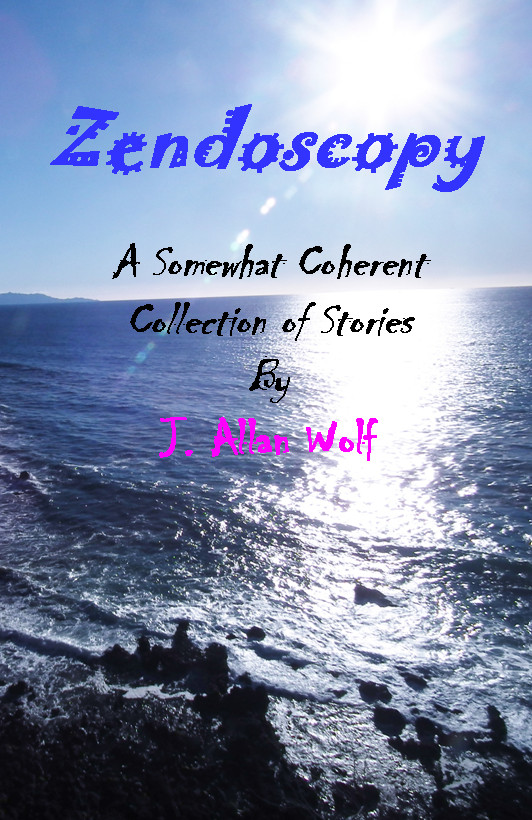
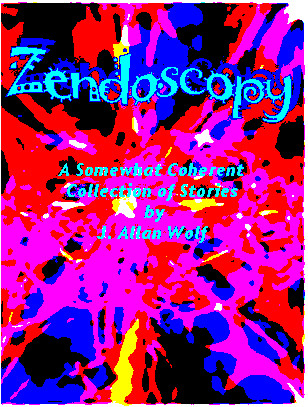
Zendoscopy Front Cover Zendoscopy Unusable Cover 1 Zendoscopy Unusable Cover


All were rejected. The bright, almost psychedelic covers were deemed too colorful for the standard mode of cover printing. The photograph was eliminated because it had nothing to do, really with the theme of the book. The graphic designers at Inkwater also hated the font I had used. All in all, they told me the designs I had submitted were, um, unprofessional. Personally, I thought they were kind of cool, but I did get the bit about the one with the photograph being irrelevant. Oh, and there was one more thing about the bright covers: I couldn’t get the rights to the psychedelic design. I sent multiple e-mails to the wallpaper & background site where I found the basic pattern, but never could get any response, even though I offered to pay for the design. Incidentally, the difference between the two is that I posterized the brighter one.

So, what to do? One of the graphic designers suggested that I look at covers of books published by MacMillan, Simon and Schuster, Hachette, et al., which I did. I hated them all, ending up seeing a lot of really dull covers. You can verify this yourself. Go to your local Barnes & Noble and check out book covers from major publishers. Dull, right?

A second graphic designer at Inkwater sent me some sample backgrounds she had located. I pretty much hated them, too. Dull to the point of awful. The pages with those designs, however, did have links to other designs, which I followed. Although not entirely happy with what I found, I did locate one design that was sort of acceptable to me and which met with approval at Inkwater. Their graphic designer went to work on it and, miracle of miracles, the cover looks pretty damn good. You’ll see it soon enough.

Interior design of the book is a much simpler matter. Words on a page, pretty standard font, a few design tweaks, and done.

In the final analysis, the job is to get books moving off the shelf, book-signing table, and internet. If looking “professional” is going to get the writing more seriously considered by book reviewers and acceptable to booksellers, then, with some regret, my attempts with psychedelia and photography have to be abandoned. Who knew?


Today’s Annoyance: The Dangling Phrase

“Running through the forest, the foliage became thicker.” So, foliage can run?

  “Screaming in pain, bystanders quickly came to his aid.”  Were the bystanders really in that much pain?

“Ducking under an awning for cover, the rain was coming down harder and harder.”  I didn’t know that rain could duck.

Some Observations on Why We’re Doomed

As I indicated in my introductory posting on Seductive Peach, one of the features of the blog would be the inclusion of an occasional essay. In that bleeding vein, the following piece is offered. Comments on the piece are welcome, but no flaming rants or death threats, please. All submissions will be reviewed, with the most reasoned and intelligent being posted…maybe.

–JW

On a certain corner near where I live in Southern California, in the parking lot of a fast food chain restaurant, there stand three flagpoles in a row. The tallest, in the center, sports an American flag. To one side of this is the California flag and, to the other, the distinctive red and yellow flag of the eatery.

This, of course, symbolizes what America has become. A nation of fat patriots, super-sizing itself into morbid obesity with hypertension, diabetes, and cardiovascular disease, and doing so with flags flying proudly.  We are not only eating everything on our plates, we’re being eaten back. But we’re Americans. Exceptional, we’re told, and immune from the problems of the rest of the world. To quote Joe Walsh, “My Life is Good.” So, let’s all  wave the flag in support of chauvinistic gluttony. But this essay really isn’t at all about fat, overindulging America, per se. It’s about the arrogant ignorance of delusional certainty.

There are at least two types of this sort of ignorance. First, there’s the type manifested by the world’s predators. These are the Tea Party, tax cut for the wealthy, sock it to the poor, run up the national debt while screaming about the deficit kind of folks. They’re the folks who have gold-plated health care coverage, think global climate change is a hoax, and can only exist by creating a clear demarcation between an “us” and a “them”. Think this is an exaggeration? If so, just recall Mitt Romney’s 47%. Or ask your local Tea Party “Patriot” whether health care in this richest of all countries should be a humanistic obligation. These folks are completely immune to arguments of reason. Trying to educate them is a total waste of time and energy. Of course, individuals may suddenly make an exception when one of theirs is involved. To wit: Dick Cheney and his lesbian daughter.

Then there’s the ignorance typified by those who are simply too stupid or educationally deficient to realize that the “haves” are screwing them right and left, but who support them anyway because, well, this is America, God’s country, where everyone has an equal chance to be filthy rich and famous.  These people have the mindset that, no matter how downtrodden and abused they may be, they’re somehow empowered and, even, chosen. They know they’re superior to godless atheists (who are condemned to hell) and undocumented immigrants (who might as well be). These are the folks who push creationism, a type of godliness right out of the picture book of ignorance. They’re the folks who give thanks to God instead of the firefighter when a baby is saved from a burning building, and who somehow manage to ignore the fact that 50 others died in the inferno.

And so, as I get older, I find myself living out a contradiction. As we age, we’re supposed to become more conservative. In my case, however, I am moving aggressively toward the opposite extreme. With each sunrise, with each day’s satisfied realization that the mirror still fogs, that I’m not yet wearing the green toupee, I am ever more the unreconstructed, unapologetic, card-carrying, left-wing, secular humanist and liberal.

<>

   “So, let me get this straight. You say that, even though I don’t believe in God, I’m still going to heaven, right?” I’m in conversation with my highly religious friend, Ralph, one of the brightest, most congenial and good natured people I know, a physician I’d trust with my life if I were in crisis and needing brain surgery.

Scratch the surface and he’s a total lunatic.

“Uh huh.”

“But ,” I add, “not to the same level of heaven as you, right?”

He demurs, looking uncomfortable. “Well,” he says, “You’ll go there because you’re a good person.”

In other words, he isn’t going to answer my question, although it doesn’t matter because I know the answer. For him, it’s a celestial heaven on his own planet.  For me, a more mundane eternity.

“And so,” I ask, “tell me about  heaven. What’s it like?”

The detail he now provides is shocking in its elaborate precision. I learn that it’s much like it is here, on old terra firma, but sort of more glow-y, doncha’ know? And we’ll all look just like we did when we looked the best we ever looked in life. Specifically, Ralph asserted that our wives would look just like they did on the day we married them, when they were, say, twenty-six.

“How do you know that God will think that’s when she looked her best? I mean, maybe He’ll think she looked best at age four.”

No answer.

Okay, moving on. “So, let’s talk about biblical history.”

“You mean, like, Father Noah?”

“Sure, that’s a good place to start. Tell me about Noah and the ark.”

“Well, it’s all in the Bible.”

“Yes, I know. But, I mean, do you believe in the Great Flood?”

“What do you mean? It’s in the Bible. It happened.”

“And Noah gathered two of every living animal: giraffes, hippos, houseflies, tapeworms…?”

“Yes.”

“Arrrgh.”

<>

   Rush Limbaugh said he’d leave the country if health care reform legislation passed Congress. It passed. He didn’t leave. Why is he still here?

<>

   Now, I do know that there is such a thing as innocent, if not blameless, ignorance. For example, we are all unintentional bigots, victims of our upbringing, inculcated with prejudices we do not even know we have until, if we are lucky, something happens to make us rub our faces in our own dishonor.

I have a friend, a good friend, one of the most generous and well-intentioned people I know. He spent his youth in a small town, isolated and religious. Thus it was that when we attended a swap meet together one sunny day in May in the early 1990s, he saw something he wanted, looked at me, and remarked, “Let’s see if I can Jew him down.”

My friend is not anti-Semitic. It just never occurred to him that this was a religious slur.

I did it once, too, that I can recall, referring in front of a close Asian friend that I thought some unlikely occurrence had a “Chinaman’s chance” of happening. It hurts to this day, because I never before had paid attention to what the phrase implied beyond the simple indication of improbability.

I am not a proponent of rigid political correctness. Nor, however, do I believe in unthinking and gratuitous promulgation of insults that have simply become ingrained without consideration of their underlying bigotry and implications.

So, I cite the two examples above as being totally inappropriate because they were uttered without thought or malevolent intent, yet they were malevolent precisely because of their absence of thought.

The conclusion is that if you want to be politically incorrect, at least understand what the hell you’re saying. And if you don’t even realize that you’re about to be politically incorrect, you probably haven’t given it enough thought.

<>

   Ralph again.

“I know you’re a good person, but how can you be good without belief?”

I ponder this for a moment, wondering just how indoctrinated some people can be. So I ask, “Do you mean to imply that the only reason you behave in admirable fashion is to keep from going to hell? The fear of some eternal punishment?”

“Hell is a terrible place.”

“I would imagine so, if I believed in it. But you didn’t answer my question.”

“Well, I guess that’s part of it.”

“And the rest?”

Now it’s Ralph’s turn to ponder. “Well, there’s the ten commandments, God’s directions to us for moral behavior.”

“But isn’t that just another way of avoiding punishment?”

“No. It’s a code to live by.”

“Same difference. And it’s a lousy code.”

“What?”
“Well,” I say, warming to the topic, “Let’s consider them, one by one.

“Let’s not be tedious.”

“Okay, how about just a few of them? Say, the one about honoring your father and mother? Even if they’re physically or mentally abusive? Or the one about lying? Did you ever lie? Even a teensy weensy one? Or, how about the thou shalt not kill thing? I believe you support capital punishment, right?”

“You’re not being fair. There are exceptions.”

“What? When did God make exceptions to His commandments?”

“Well, we all know there are exceptions.”

“I give up.”

There is simply no way to impress someone with logic, reason, or even facts when a wall of self-deception, ignorance, or defensive denial is in place. And that is why, for example,  some people cannot be convinced that President Obama was born in the U.S., that our planet is more than 6000 years old and that, the Flintstones notwithstanding, humans didn’t coexist with dinosaurs. It is, finally, arrogance born of indoctrinated ignorance.

It’s enough to make a rational person cry.

Today’s Annoyance – People who don’t know the difference between nominative and objective cases: To wit, we hear all too often something on the order of, “He gave the tickets to you and I.” This type of error appears very commonly in pop music. For example, Elton John makes it in Daniel: “…Daniel my brother, you are older than me…” Arrrgh! If you don’t know what’s wrong in these examples, you may need to review elementary school grammar.